The libcrypto.so.1.0.0 error stops Packet Tracer from launching due to a missing crypto lib. You fix it by first updating your package list and installing the libssl1.0.0 package. If the app still fails, you copy the library file straight into /opt/pt/bin and overwrite the old one. Then, you run the PacketTracer7 binary again, and the simulator starts right up. This method works the same across Ubuntu, Debian, and Mint for this CVOICE lab tool. So, you keep your Cisco study lab alive without downgrading the whole OS.
Are you facing the “libcrypto.so.1.0.0” error while installing Cisco Packet Tracer on your Linux system? Don’t worry; I found the solution for you and shared it!
In this article, I will explain the step-by-step process to resolve this error as well as how to run Packet Tracer on Linux. However, you may encounter this issue even if you are using Ubuntu, Debian, or Linux Mint. Therefore, you can quickly resolve the “libcrypto.so.1.0.0” issue.
How to Fix (libcrypto.so.1.0.0: no version information available for Packet Tracer7) Error on Linux
You may encounter compatibility issues while installing Cisco Packet Tracer on Linux-based systems. You may also see such matters, especially on distributions such as Ubuntu, Debian, and Linux Mint.
However, this simulator program is essential when preparing for Cisco exams. As a result, following the proper steps will help you solve these compatibility issues.
Installing Packet Tracer on Windows 11 & 10 is usually straightforward. However, this may be different on Linux systems. In addition, you may encounter more compatibility issues on Linux operating systems. In short, you may need to be more careful on Linux with the proper steps.
You may be tempted to update when a new Linux distribution is released. However, you should first backup your host PC. Also, programs like Packet Tracer may not work correctly on the latest versions. Therefore, be careful before updating. Because by taking a backup, you prevent possible problems.
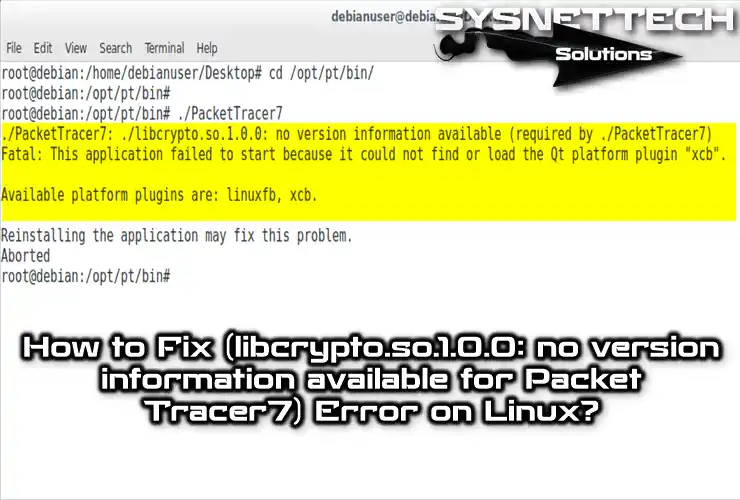
Let’s say you received the error “libcrypto.so.1.0.0: no version information available required by ./Packet Tracer7” while installing PT on Linux/Debian OS. In this case, you will be able to use Packet Tracer without any problems by following the steps below.
Troubleshoot Packet Tracer Error
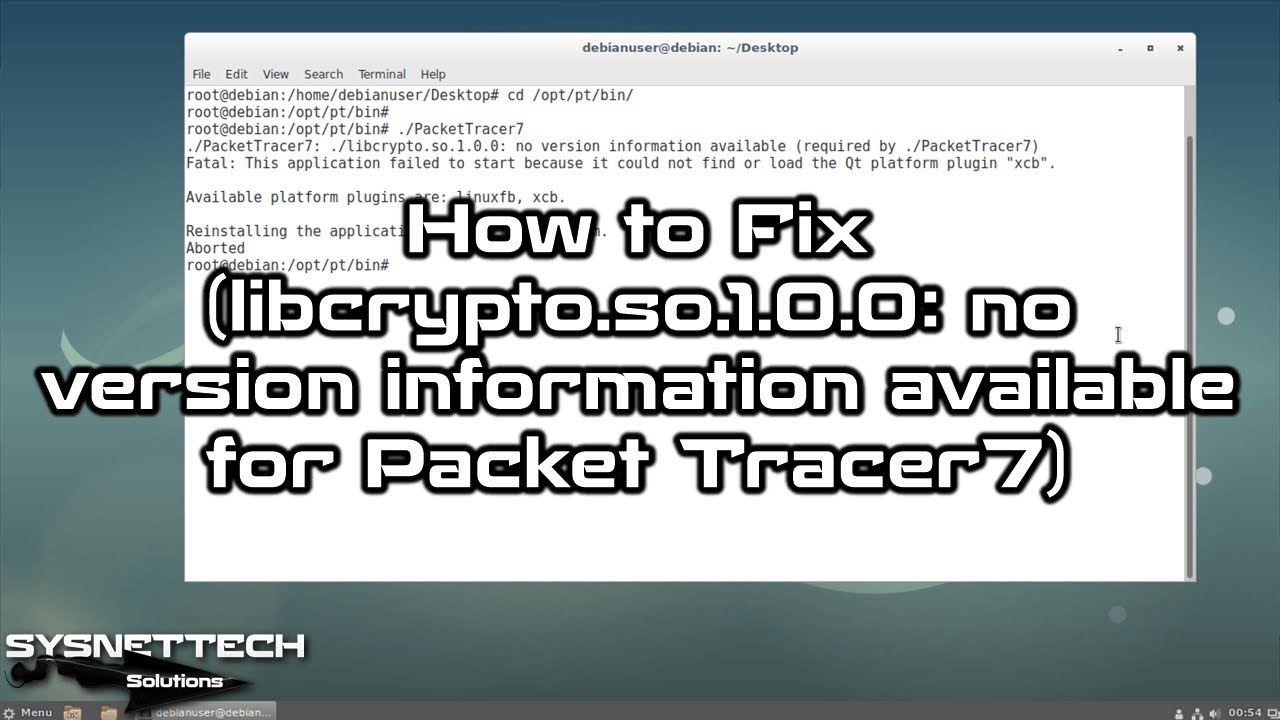
For example, when running Packet Tracer on Linux, you encountered this error in the terminal. At this point, you should check if the package is installed on your system. However, if the package is installed but PT still does not open, you need to reinstall the package.
So, what is “libcrypto.so.1.0.0”? This package is a cryptography library for C++ programs. We also use it to create programs using cryptographic algorithms. The library uses the Pipes and Filters architecture.
If you want to get more information about this package, you can check the Debian Pkgs source. Also, to fix this error on Linux, you must first open the terminal on your desktop. Then, you also need to get root access. In addition, to install the libcrypto package required for the Cisco simulator, execute the following commands.
1) sudo apt-get update
2) sudo apt-get install libssl1.0.0
./PacketTracer7 komutunu tekrar uyguladığınız aynı hata ile karşılaşırsanız bir sonraki komutu uygulayınız.
3) cp -i /usr/lib/x86_64-linux-gnu/libcrypto.so.1.0.0 /opt/pt/bin/
cp: overwrite '/opt/pt/bin/libcrypto.so.1.0.0'? Y -->> Yes (Y) tuşuna basın.
4) ./PacketTracer7
Starting Cisco Packet Tracer…
If you get an error while installing the libssl1.0.0 package, update your repository. Precisely, you should edit /etc/apt/sources.list file. So, make sure your repositories are correct. This will help you to solve the installation problem. If you still cannot install libssl1.0.0, you can use the following commands.
Even with up-to-date software sources, things can sometimes go wrong when installing packages. You may see a common problem, especially if another program install was stopped before it finished: the dpkg database freezes. This can also make the apt-get update command show an error.
Watch the video below to decode and install this package on your Linux OS. Plus, you can subscribe to our YouTube channel to support us wholeheartedly!
What is libcrypto.so.1.0.0 and why does Packet Tracer need this file?
This is a cryptography library. It belongs to an old version of the OpenSSL package. Programs use it for operations like encryption and authentication.
Packet Tracer 7.x series specifically looks for the 1.0.0 version. The developers wrote code compatible with this version at that time. So, the instructions in the program’s brain directly call this file.
However, this version is not present in new Linux distributions. Instead, there are current versions like 1.1 or 3.0. When Packet Tracer cannot find the old one, it throws an error at you. The system warns with ‘no version information available’.
Actually, the program can sometimes run despite this warning. But it creates a security risk or instability. You do not want such uncertainty while preparing for Cisco exams. That is why you must properly bring this library into the system.
How do I fix this error on Ubuntu or Linux Mint?
Open the terminal and first update the repositories. Start with the ‘sudo apt-get update’ command. Then type ‘sudo apt-get install libssl1.0.0’.
This command installs the old library on your system. The problem is solved in most cases. When you run Packet Tracer again, the error disappears.
Let’s say you got a ‘package not found’ error during installation. Then you need to check your repository list. Open the /etc/apt/sources.list file and make sure the universe and multiverse repositories are active.
There is also an alternative way. You can directly copy the libcrypto.so.1.0.0 file to Packet Tracer’s folder. To do this, first find the location of the file on the system. It is usually under /usr/lib/x86_64-linux-gnu/.
Then run the ‘sudo cp /usr/lib/x86_64-linux-gnu/libcrypto.so.1.0.0 /opt/pt/bin/’ command. If it asks whether you want to overwrite during copying, press the Y (Yes) key. This manual method has worked for many users.
If the sudo apt-get install libssl1.0.0 command doesn’t work, what else can I try?
Sometimes old packages have been removed from the main repositories. You may encounter this situation especially on Ubuntu 20.04 and later. Do not panic, we will do a manual installation for the solution.
What you actually need is the libcrypto.so.1.0.0 file. This file comes inside the libssl1.0.0 package. But if you cannot find the package, you can directly download the .deb file.
You can get an old version from the Debian archives. For example, you can solve another dependency with the command ‘wget https://ftp.debian.org/debian/pool/main/libp/libpng/libpng12-0_1.2.50-2+deb8u3_amd64.deb’. This command actually downloads libpng12. But you can follow a similar method for libcrypto as well.
Honestly, the most solid solution is to copy the library next to Packet Tracer. Try the cp command I explained above. If libcrypto.so.1.0.0 is completely missing from the system, then you may need to download it from a different source.
Remember, packaging systems like Snap or Flatpak can also be alternatives for such old dependencies. The Snap version of Packet Tracer may not experience this problem. But if you insist on a local installation, the manual copying method is the fastest.
Is it safe to copy the libcrypto.so.1.0.0 file to the Packet Tracer folder?
Yes, this method is widely used and harmless. You are just adding the library the program needs to its own working directory. It does not affect the rest of the system.
The file you copied comes from an original libssl package. As long as it is downloaded from trusted repositories, it does not contain viruses or malicious code. Still, prefer files whose source you know.
You are doing this operation with root privileges. So, you are using the ‘sudo cp’ command. The only point you need to pay attention to is that the target folder is correct. Packet Tracer is usually installed under /opt/pt/bin/.
Before copying, check if there is a file with the same name there. If there is, it might be a good idea to back it up before overwriting. But in most cases, the file is either missing or corrupted.
You can use a similar approach for other old programs as well. For example, some commercial software looks for libpng12. You can copy that with the same logic. Just pay attention to the version compatibility of the library.
Why does Packet Tracer stop working after I update my Linux distribution?
Old libraries are removed during the update. The system switches to newer and more secure versions. Packet Tracer, however, still continues to search for the same old file.
On the other hand, your distribution’s package manager rearranges the dependencies. Since libcrypto.so.1.0.0 is no longer present on the system, the program does not start. The error message appears clearly when you run it from the terminal.
Otherwise, it is wise to take a backup before the update. Especially copy the files in the /opt/pt/bin/ directory out. You can move this backup back after the update.
Because many users skip the backup in the excitement of the new version. Then they search for a solution for hours. A backup you take in seconds can save you weeks of time.
In the end, if you use Packet Tracer regularly, do not update immediately. First, read the compatibility notes on forums or Cisco’s own documents. Sometimes the next Packet Tracer version awaits the update.
How can I permanently solve this compatibility issue on Linux?
There are two ways for a permanent solution. The first is to install Packet Tracer as an encapsulated package like Snap or Flatpak. These systems carry dependencies within themselves and are not affected by updates.
The second is to manually copy the libcrypto.so.1.0.0 file after every update. You can turn this into a script. Running the script after each system update is enough.
For example, create a bash script. Write ‘sudo cp /usr/lib/x86_64-linux-gnu/libcrypto.so.1.0.0 /opt/pt/bin/’ inside it. You can place this script in a location like /etc/cron.weekly/. Let it run automatically once a week.
However, the real permanent solution comes from Cisco itself. The company needs to compile Linux versions with up-to-date libraries. Unfortunately, this can sometimes take years. That is why users like us are stuck with these temporary methods.
Moreover, this problem is not unique to Packet Tracer. Many commercial software on Linux suffer from the same trouble. My advice is to stay on an LTS version for your critical work. Update every five years, not every two. This way, you escape the dependency chaos.
Conclusion
In conclusion, you can run the Cisco simulator 7.2 on Linux. You can use the method I mentioned in this article. Additionally, this method is straightforward and effective. So you can troubleshoot and solve the “libcrypto.so.1.0.0” issue.
They'll Thank You for Discovering This Guide!
Ready to do your loved ones a huge favor with just one click? Knowledge grows as it is shared.
Hi, I'm Tolga, a computer expert with 20 years of experience. I help fix computer issues with things like hardware, systems, networks, virtualization, servers, and operating systems. Check out my website for helpful info, and feel free to ask me anything. Keep yourself in the loop about the newest technologies!
1240 Articles
1 Reader Comment
PGo
Any twin guide for those of us using Fedora 28 and getting an error such as “/opt/pt/bin/PacketTracer7: /usr/lib64/libcrypto.so.1.0.0: no version information available (required by /opt/pt/bin/PacketTracer7)
QFSFileEngine::open: No file name specified”? That library just doesn’t exist for Fedora’s package manager.



1 Reader Comment
Any twin guide for those of us using Fedora 28 and getting an error such as “/opt/pt/bin/PacketTracer7: /usr/lib64/libcrypto.so.1.0.0: no version information available (required by /opt/pt/bin/PacketTracer7)
QFSFileEngine::open: No file name specified”? That library just doesn’t exist for Fedora’s package manager.