How to Create a RamDisk using ImDisk Virtual Disk Toolkit
Quick Insight
You create a RamDisk by installing the free ImDisk Virtual Disk Toolkit first. You open the app and click Mount New Virtual Disk from the File menu. In the settings you set a size in gigabytes and pick the physical memory option. After you click OK the tool shows a new drive letter in My Computer. You then format that fresh volume and use a speed test to confirm it beats even SSDs. So you turn spare RAM into a blazing fast workspace for your heaviest apps.
In this article, we examine how to create a RamDisk. We use the ImDisk Virtual Disk Toolkit software.
How to Create a RAMDisk using ImDisk
We must create a RAMDisk. This lets you allocate HDD space on your computer’s RAM hardware. For this reason, all programs in this area run much faster. Therefore, if you want such a setting on your PC, we recommend ImDisk.
We can also use the Dataram program as an alternative to the Virtual Driver Tool. However, Dataram is a paid program. Therefore, it only lets us create 1 GB of space.
To make a simulated RAM drive, download the program first. Click the button below.
Download the ImDisk program to your computer. Extract the RAR file to a folder. Then, follow the steps below to use it on your Windows OS.
Steps:
Step 1
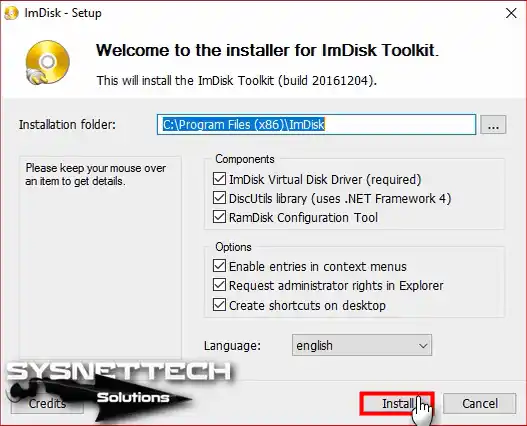
Run the virtual drive tool file as an administrator. Then, select the installation location. Click Next.
Step 2
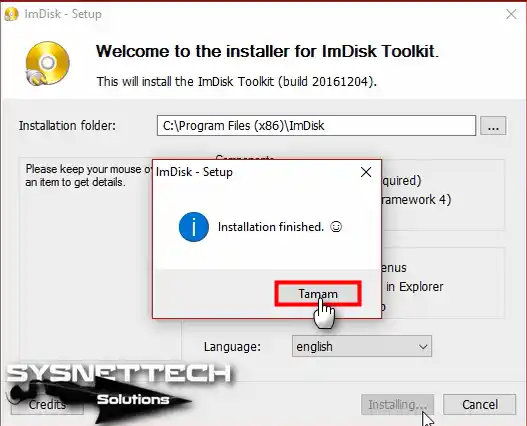
After you install ImDisk, click OK.
Step 3
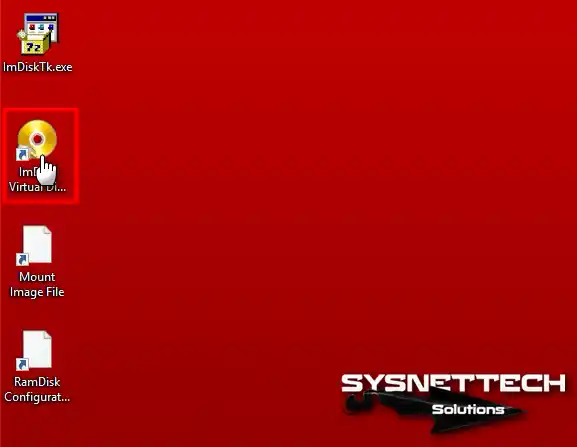
Run the program. Double-click the ImDisk shortcut on the desktop. The wizard created this shortcut.
Step 4
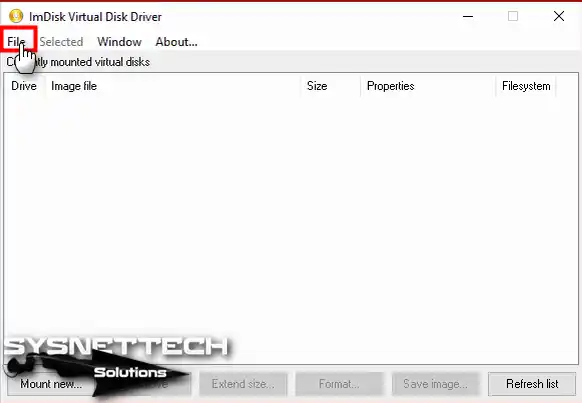
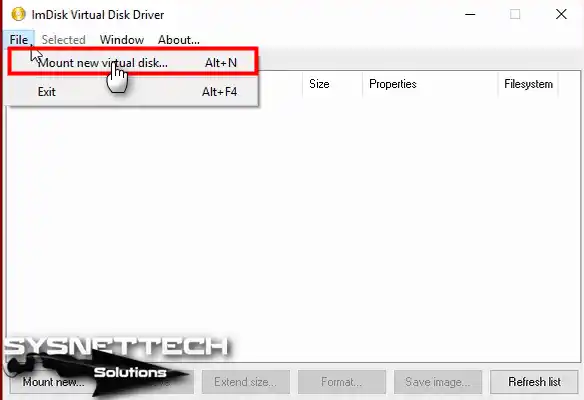
On the Virtual Driver screen, click File from the menu.
Step 5
Click on Mount new virtual disk.
Step 6
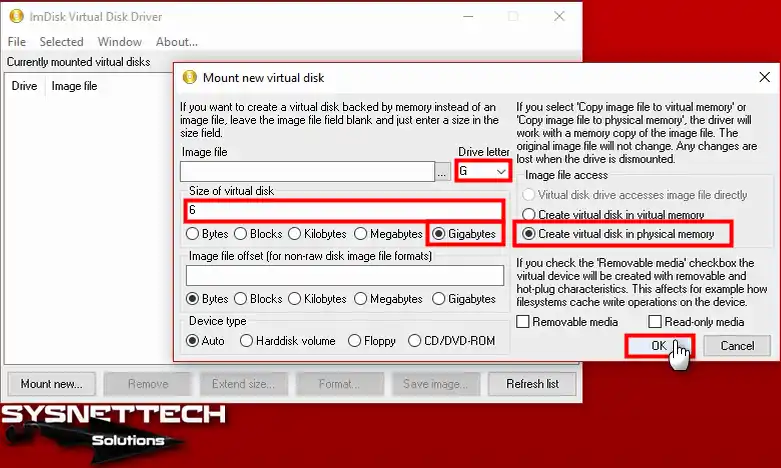
The Mount New Virtual Disk settings open. You must set a value based on your computer’s RAM capacity. This creates new space on your system. For example, on an 8 GB RAM computer, allocate 4 GB or 6 GB.
Type the RAMDisk space value in the size field. Select the Gigabytes option.
In the Image file access area, select Create a virtual disk in physical memory. Then, click OK.
Step 7
You have successfully configured a new RAMDisk space on PC!
Step 8
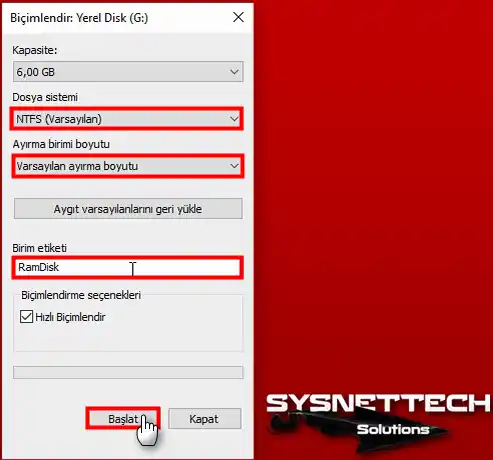
After you create it, you must format the drive. After checking its drive letter, format the drive as follows.
Step 9
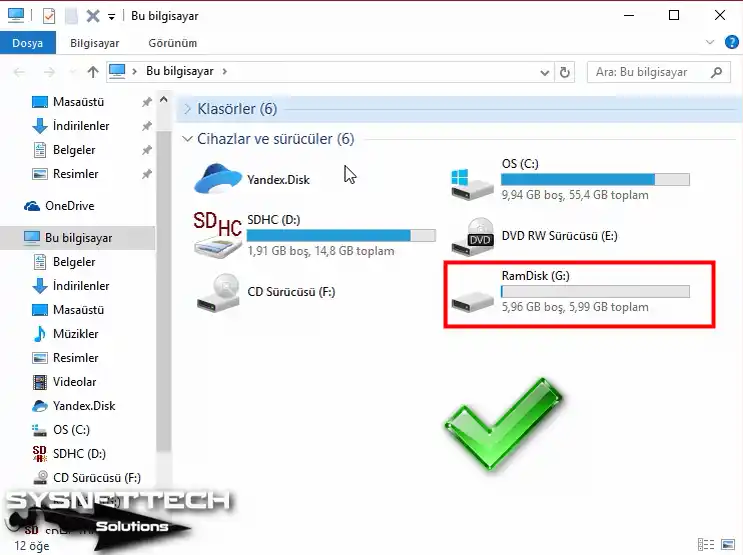
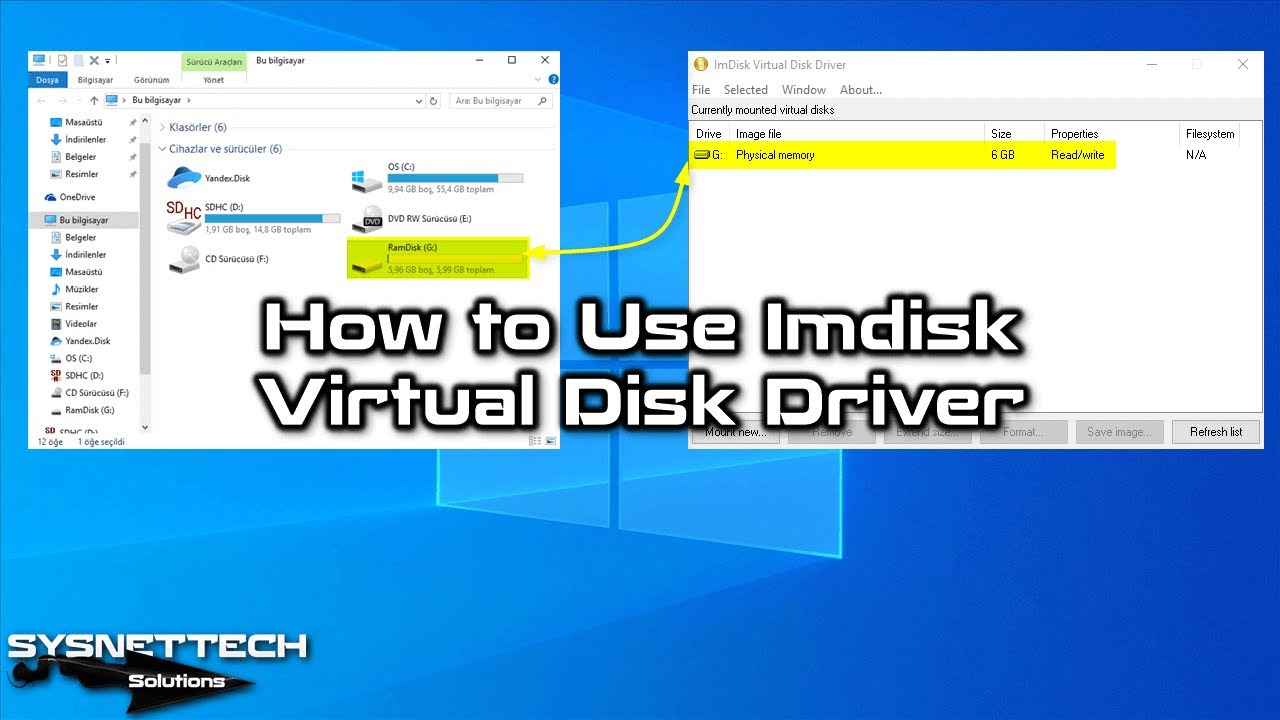
Click My Computer. Then, you can see your new virtual drive. It is now available.
How to Check Virtual Drive Speed Test
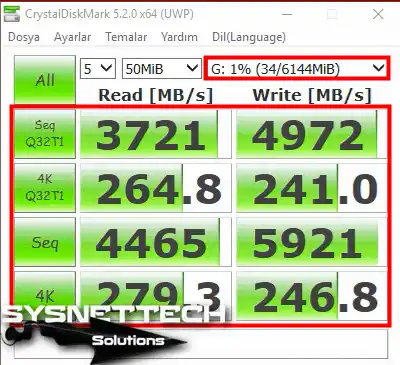
You can use Crystal Disk Mark to test RAMDisk speeds. This tool checks write and read speeds. You created the RAMDisk using ImDisk.
Download the Crystal Disk Mark program to your computer to test disk speeds. Then, test the speeds of your RAMDisk, as shown in the image below. As you can see, it is even faster than SSD Disks.
Along with speed tests, you should also check your drive health. In my experience, regular testing extends drive life. You will find our guide for HDD and SSD health testing very helpful.
What is ImDisk Virtual Disk Toolkit and what does it do?
Actually, ImDisk is a free tool that turns part of your RAM into a virtual disk drive. You set aside HDD space in your computer’s RAM. Programs you install in this space run much faster.
However, normal hard disks look very slow next to this speed. The RAMDisk you create is far faster than even SSDs. So install programs here, and they run at once.
It is also a perfect fix for temp files and browser caches. You get a clean disk on every boot. For lasting data, use your normal HDD or SSD.
Unlike paid tools like Dataram, ImDisk is fully free and offers endless space. Once you set it up, you use it for life. It is one of the best ways to boost your PC speed.
How do you create a RAM disk and set its size?
First of all, run the program as an admin. Next, click the ‘Mount new virtual disk’ option in the File menu. The Mount New Virtual Disk settings appear.
Type the size you want in the ‘Size of virtual disk’ field. Check the Gigabytes option. In the Image file access area, pick ‘Create virtual disk in physical memory’.
You must pick a value based on your computer’s RAM. For example, 8 GB RAM can host 4 GB or 6 GB of RAMDisk space. Do not set aside more than 75% of your total RAM.
Click OK to make the virtual space. After that, you must format the drive. I suggest you pick the NTFS file system. Quick format is enough. Full format is not needed.
How do you fix the access denied error during setup?
This error is usually about admin rights. Right-click the setup file. Pick the ‘Run as administrator’ option.
When the problem goes on, turn off your antivirus for a bit. ImDisk is a tool that runs at the system level. As a result, some security tools try to block it.
On the other hand, you can try compatibility mode. Right-click the setup file, then go to Properties. In the Compatibility tab, pick Windows 8 or Windows 7 mode.
Still seeing the error? Check your user account control settings. From the Control Panel, lower the UAC level for a bit. After setup, raise it back up.
Does ImDisk work with Windows 11?
It sure does. ImDisk is fully compatible with Windows 11. In fact, you can use it on Windows 10, 8.1, and 7 too.
You only need to grant admin rights during setup. Windows 11 security layers sometimes try to block older tools. In this case, compatibility mode comes into play.
I myself made a 6 GB RAMDisk on Windows 11. Afterward, I tested it with Crystal Disk Mark. The results were wild: I hit 5000 MB/s read speed.
You face no driver signature block either. ImDisk uses a signed driver. That way, it does not clash with Windows 11 core security.
How do you mount an ISO file to a virtual drive?
This is one of ImDisk’s best features. You can mount ISO files without loading them into RAM. Open the program and go to the File menu.
Click the ‘Mount new virtual disk’ option. Pick your ISO file in the Image file area. Check the ‘Open image file as read-only’ option.
Then press OK. Your ISO mounts at once as a virtual drive. You see a new DVD drive in My Computer.
This method lets you install an OS without a physical DVD. Also, you can run game ISOs this way. To remove the disk, use the ‘Unmount’ option.
Why does the RAM disk vanish when the PC shuts down?
This is how RAM works. When power cuts off, all data in RAM vanishes. In fact, this is not a loss, but a big plus.
It is ideal for temp files, browser caches, and programs you use often. You get a clean disk on every boot. For lasting data, use your normal HDD or SSD.
Think of RAMDisk as a fast temp drive. When you shut down the PC, everything in it flies away. Therefore, never save your key files here.
If you want to keep the data, what should you do? You can use ImDisk’s ‘Save image’ feature. This feature saves the RAMDisk contents to an image file. You load it again when you boot up.
How do you use virtual disk command line parameters?
ImDisk’s command line interface (CLI) is quite strong. You use the imdguard.exe or imdisk.exe file. Open the command prompt as an admin.
You can make a new RAMDisk with this command: imdisk -a -s 6G -m R: -p “/fs:ntfs /q /y”. This command creates the R drive with 6 GB. It does a quick format using NTFS.
You do not have to memorize the flags. Plus, ImDisk’s help menu lists all options. You reach this list with the ‘imdisk -h’ command.
You can build batch files to make a RAMDisk on every boot. Add a task to Task Scheduler. So the command runs when the PC boots.
What is the difference between dynamic memory and fixed allocation?
In fixed mode, you set aside the amount of RAM at once. Pick 6 GB, and your system loses 6 GB. This amount stays fixed until you delete the RAMDisk.
With dynamic memory, you use RAM only when needed. You set aside a small space at the start. This space grows as you write data.
ImDisk uses dynamic memory by default. But the ‘Create virtual disk in physical memory’ option gives fixed allocation. Which one should you pick?
Pick fixed mode if you want speed. Dynamic mode adds overhead as data grows. Fixed allocation always gives you steady speed.
Use the dynamic option when memory is tight. That way, RAM does not go to waste when you do not use the RAMDisk.
Why do antiviruses flag ImDisk as harmful?
This case is quite common and usually a false alarm. ImDisk runs at the system level. It asks for rights to create and mount drives.
Antivirus tools see such low-level access as suspicious. Above all, tools that make virtual drives use a trick that malware also uses. Because of this, the heuristic scan warns you.
The fix is simple: add ImDisk to your antivirus allow list. Exclude the setup file and the program folder. Next, try the setup again.
Alternatively, you can turn off the antivirus before setup. Turn it back on after setup. You will have no issues. Worried about safety? Scan the files on VirusTotal. On top of that, ImDisk is an open-source project. You can look over the source code yourself.
How do you mount a virtual disk to a folder?
You can use a folder path instead of a drive letter. This feature is very handy for developers. In the Mount settings, type the folder path in the ‘Mount point’ field.
For example, pick the C:\RAMDisk folder. This folder must already exist. Otherwise, ImDisk will not make it on its own.
Once the mount is done, that folder stores every file in RAM. You use the folder like any normal directory. But in the background, you get RAM speed.
The plus of this method is that you skip the drive-letter mess. It is ideal for web servers and database apps above all. Point your app’s cache folder to this folder.
To remove it, click the ‘Unmount’ option in the Mount settings. The folder empties and returns to normal.
Conclusion
All in all, using the ImDisk Virtual Disk Toolkit is simple. Thus, we can create a unique space, namely RAMDisk, on our PC. In this way, we can significantly increase our disk performance where necessary.
In short, we can install programs by allocating an HDD space to the RAM hardware. As a result, we can work much faster than with traditional hard drives or SSDs.
The installation process is simple. You can run it on your OS with this guide. Then, you can create a RAMDisk in a short time. If you want to improve your PC’s performance, I highly recommend this tool.
They'll Thank You for Discovering This Guide!
Ready to do your loved ones a huge favor with just one click? Knowledge grows as it is shared.
Hi, I'm Tolga, a computer expert with 20 years of experience. I help fix computer issues with things like hardware, systems, networks, virtualization, servers, and operating systems. Check out my website for helpful info, and feel free to ask me anything. Keep yourself in the loop about the newest technologies!





Be the first to share your comment