

We often use the CLI (Command Line Interface) on Cisco devices. It helps us set up network tools like Routers and Switches. With this tool, we set up jobs, fix problems, and watch devices by typing different commands.
The CLI works in different ways. First, there is User EXEC mode. In this mode, users can use simple commands. With these commands, we can see the device’s state and get more details.
Next is Privileged EXEC mode, which uses stronger commands. Here, we can change the setup and also adjust the device’s settings.
This ordered method gives us exact control. Also, it helps us handle network setups well. In all, Cisco CLI keeps things steady and fast in network work.
What is Cisco CLI?
The Cisco CLI, or Command Line Interface, is a strong tool. We use it to work with Cisco networking devices like Routers and Switches.
This text-based tool lets network workers do many kinds of jobs. These jobs include setting up tools, fixing issues, and checking how they work. Of course, users can type orders straight into the system.
With the Cisco CLI, users can change between different working modes. Each option has its own specific purpose. Starting in User mode, users can see basic facts. But they can only execute simple orders in this format.
They can then raise their power to Privileged mode. This lets them use harder orders and change setups.
Finally, in Global config mode, users can make vast changes to the device. This makes it a key tool for correctly handling network systems.
We like the CLI because it works well and is fast. This lets skilled users run orders quick. But this is also key when time is very short.
While it may look hard for new users, learning the Cisco CLI is very important. It gives complete control over network setups and work.
In most cases, a better understanding of Router modes lets us make strong and safe networks. But, if the CLI is complex, do not fret; you can also handle your tools from the GUI with tools like SDM.
What are the Cisco Router IOS Configuration Modes?
A Cisco Router works in three modes. Each model has a special job. These are User EXEC, Privileged EXEC, and Global configuration.
Using the correct commands is very important for Router setup. For example, we can give an IP address to an interface with the “ip address” command. But we must do this task in a global setup format.
After turning on a setting in the CLI, you can go back to it. This makes sure that the Router setup steps can be handled easily. In fact, this way lets us be exact and helpful when setting up.
1. User Executive Mode
The first mode of the CLI is the User EXEC. In this level, we can see basic facts about our devices.
These facts include the system’s state, its setup details, and how to fix problems. But we cannot change the setup or run system commands.
To move to the next mode, we execute the “enable” command. This means, with this command, we go from User to Privileged EXEC. In this new level, we can run many more control choices.

2. Privileged Execute Mode
In privileged mode, we can use critical functions. These tools are for handling and setting up the Router. This level lets us save working Router configurations.
Also, we can look at the current setup details. We can also see the Router’s IOS (Internetwork Operating System) version.
A key part of this level is being able to make a password. It is very key to lock access by creating a password. Without one, bad users can fully control our Routers.
Of course, if they run bad commands like “R1# erase,” they can wipe the whole setup and break our device. So, we must guard this mode with a strong password for network safety.
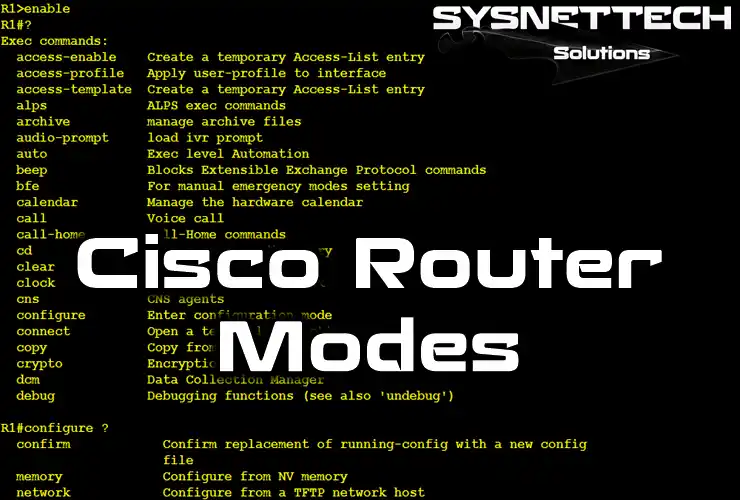
As you see in the picture, we can see all current choices with the “?” key. In other words, we can show all the commands we can execute at this level.
For example, by writing “R1# copy?”, we can see all commands for file copying. We can also see choices for saving setups to other places or types.
In short, the Privileged area is a key piece of Router control. Also, knowing how to use this level safely is key for network managers.

3 . Global Configuration Mode
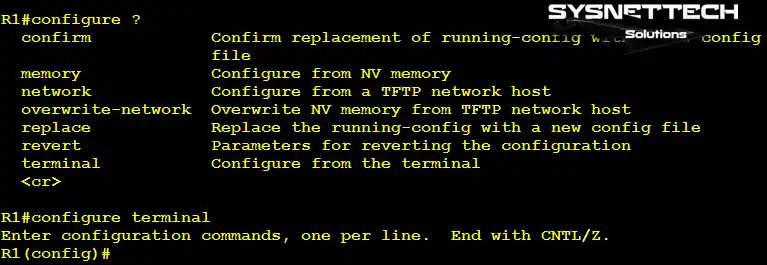
To get into Global Setup, we must first use the “configure terminal” command. We use this command from Privileged. Then, we can reach many settings for the whole Router.
Global Setup mode is usually critical. This level lets us change the device’s setup.
We do most of our setup jobs in this mode. In all, we can set rules that change the entire Router here.
For example, if you want to start the FastEthernet port, run this command:
R1(config)# interface FastEthernet 0/0After you enter this command, “ip address” comes into play. So, this means we must execute it to add an IP address to our device. We can also set a subnet mask like this:
R1(config-if)# ip address 192.168.1.1 255.255.255.0Plus, you need to turn on the port like this:
R1(config-if)# no shutdownWith this set of commands, we can open and close the Router or Switch port. Then, we can set the IP details more closely.
First, we also need to know how to move around in Global Setup Mode. This is key to reasonable Router control. It also helps with a proper network setup.
How Can I Change Modes in the Cisco Router CLI?
In the Cisco Router Command Line, we can easily change between modes. This lets us efficiently run different commands and configuration jobs.
For example, we can use “disable” to go from privileged to user. This is also called “down mode.” This command lowers our access level. So, we cannot use higher-level commands here.
We may want to leave global setup mode. To do this, we use the “End” key or the “Ctrl+Z” key.
The “End” command stops the setup session, meaning we go back to the privileged level. Also, “Ctrl+Z” lets us quickly leave sub-modes.
These tools help us work faster and make moving through the CLI simpler. This lets both network managers and us handle and set up our Routers well.

Table of Basic CLI Commands for Cisco Router Modes
You can see the simple CLI orders for the Cisco Router modes I have made for you in the list below.
As I said, these let us set up our tools more easily. This list sorts the needed orders in different Router modes. It gives a short guide for everyday jobs in all configurations.
| Mode | Command | Description |
|---|---|---|
| User EXEC | enable or en | Switches to Privileged EXEC mode |
ping <target> | Tests connectivity to an IP address | |
traceroute <target> | Traces a path to a destination | |
show version | Displays basic system information about the Router | |
| Privileged EXEC | configure terminal or conf t | Switches to Global Configuration mode |
show running-config | Displays the current (in RAM) configuration | |
show startup-config | Displays the startup configuration (in NVRAM) | |
show interfaces | Shows the status of all interfaces | |
show ip route | Displays the routing table | |
copy running-config startup-config or wr | Saves the current configuration | |
reload | Restarts the device | |
| Global Configuration | hostname <name> | Assigns a hostname to the device |
interface <interface-name> | Configures a specific interface | |
enable secret <password> | Sets the privileged form password with an encrypted password | |
line console 0 | Configures console access | |
banner motd #message# | Sets the Message of the Day (MOTD) | |
ip route <destination-network> <mask> <next-ip> | Adds a static route |
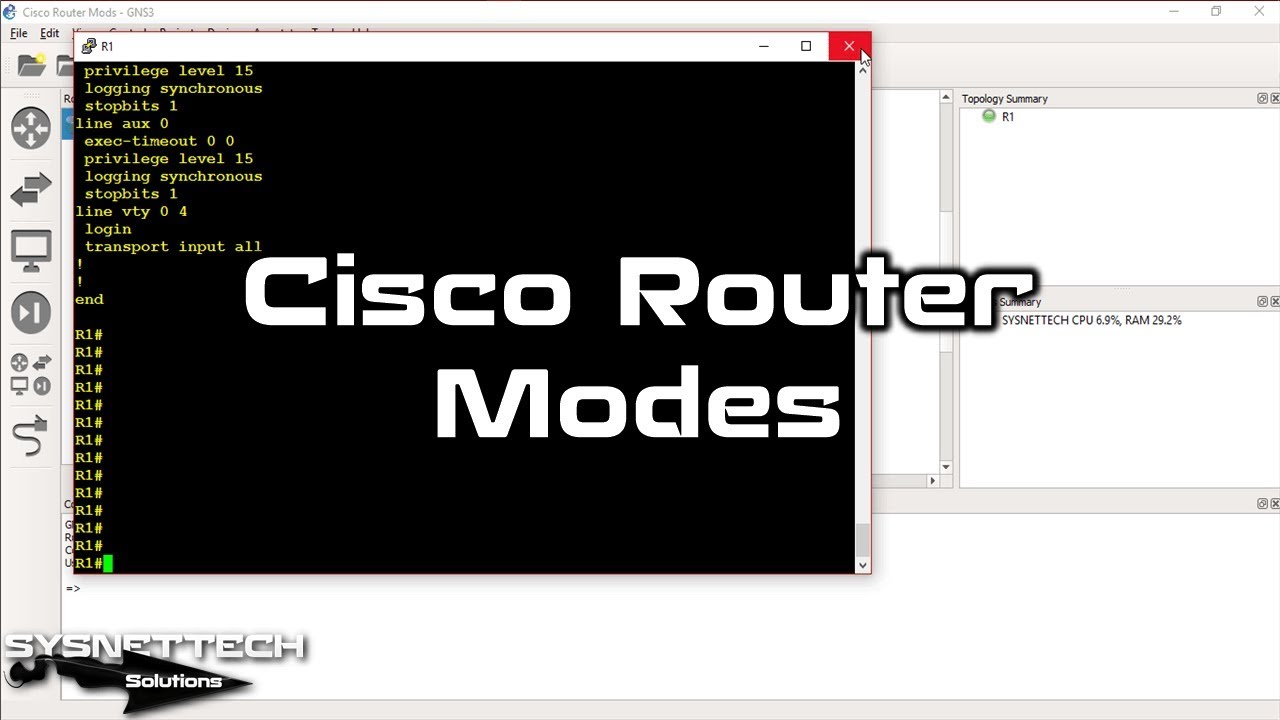
CLI Modes ⇒ Video
We have a YouTube guide video to help you learn how to use the Cisco CLI. It will show you the simple commands.
It also shows the best ways to set up and handle your Router. After, please help our work by joining our YouTube channel so we can be the first to see new guides!
Frequently Asked Questions (FAQ) About the Cisco CLI
- What kinds of modes can you use on Cisco Routers?
- How can I switch between Cisco modes?
- Can I view past commands in the CLI?
Conclusion
To finish, learning the Cisco CLI tool is very important. It is needed for anyone using network tools. These tools include Routers and Switches.
Each configuration level serves a specific purpose. The modes are User, Privileged, and Global Configuration. Each stage gives us different kinds of control. In short, this lets us shape our tools in a careful way.
Also, we can watch our tools to stop possible issues. If we know how to use these modes, we can set up many tools quickly.
With technological advances, we need to keep up with the demands of the times. So, while getting ready for Cisco exams, we should learn the CLI tool more deeply!
Let’s say you have set up your Cisco device with simple orders. But, I say you should save your setup to a TFTP server. So, see our guide, “Backing Up Cisco Router Configuration to a TFTP Server in GNS3.” So, this guide will give you good facts and show you the simple orders.

2 People Shared Their Experience
I try to set up only after studing the instructions that will tell me how to take each step correctly.
I hope my article was useful. Thanks for your comment!