
CMOS or MOS gates (Complementary Metal-Oxide Semiconductor) refer to the use of two types of transistors in the output circuit in a configuration similar to the TTL family totem pole.
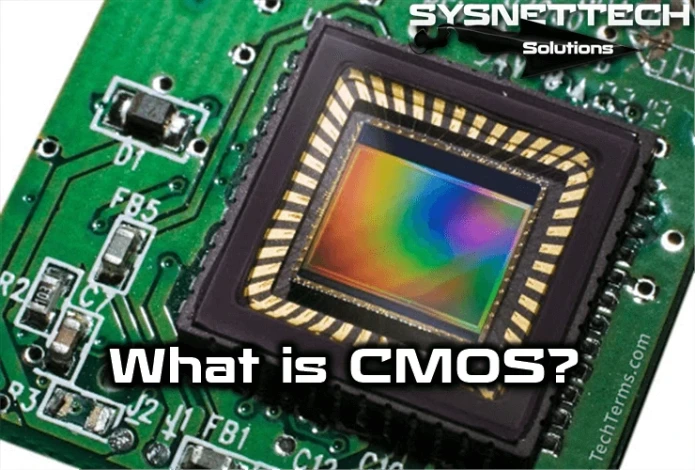
What is CMOS (Complementary Metal-Oxide Semiconductor)?
Both n-channel (NMOS) and p-channel (PMOS) MOSFETs are used together in circuits. This combination offers several advantages. First, it is faster than other types of MOS technologies. Additionally, it consumes less power.
However, these benefits come with some downsides. The IC fabrication process is complex. Also, the integration density is lower. Therefore, this technology cannot compete with standard MOS in high-density LSI applications.
CMOS Properties
1) Charge Factor
CMOS, like N-MOS and P-MOS, has high input resistance. This resistance is about 10 * 12Ω and draws minimal current from the signal source. Each input typically presents a 5pF load to ground. Because of this input capacitance, a single output can handle only a limited number of inputs.
Next, the load factor relates to the maximum allowable propagation delay. Usually, this load factor is 50 for low frequencies, under 1 MHz. However, this factor decreases at higher frequencies.
Additionally, the CMOS output must charge and discharge the total input capacitance. Therefore, as more loads are driven, the output switching time increases. Each added load raises the conduction delay by three nanoseconds. In conclusion, the load factor is crucial and depends on the maximum allowable propagation delay.
2) Switching Speed
CMOS circuits rely on large load capacitances, using N-MOS and P-MOS transistors. Higher switching speeds result from their low output resistance. For example, an N-MOS output needs to load the capacitance with a resistance of 100 kΩ.
In the HIGH state, the output resistance is based on the RON value of the P-MOSFET. This value is usually 1 kΩ or less, which speeds up capacitance charging. The switching speed also depends on the supply voltage. For instance, in a 4000 series NAND gate, the propagation time is 50 ns at VDD = 5 V and 25 ns at VDD = 10 V.
Thus, we can operate at higher frequencies even with a larger VDD. However, increasing VDD raises power loss. A 74HC or 7411CT series NAND gate has an average tpd of about 8 ns at VDD = 5 V. This speed is similar to that of the 74LS series.
3) Power Distribution
Power dissipation behaves differently in TTL and CMOS gates. In TTL gates, it remains constant across the operating range. However, in CMOS gates, it varies with frequency.
In a DC scenario, a DCOS CI shows very low power dissipation. Yet, power consumption grows with frequency. Each time an output switches from LOW to HIGH, it needs peak current. This current temporarily charges the load capacitance.
The load capacitance includes the input capacitances of the driven loads. It also consists of the device’s output capacitance. The power supply, VDD, provides these short bursts of current. Typically, the average current can reach 5 mA and lasts for 20 to 30 ns.
As switching frequency increases, more current increments occur each second. Consequently, the average VDD current rises. Thus, at high frequencies, CMOS loses some advantages over other logic families.
Generally, a CMOS gate’s power dissipation matches that of a 74LS gate at 2 to 3 MHz. However, CI MSI situations are more complex. A logic designer needs to analyze carefully. They must determine if CMOS offers a power dissipation advantage at specific frequencies.
4) Supply Voltage
TTL bipolar circuits need a voltage power supply with minimal drift. These circuits support a broader power range. For the HC and AC series, the range is +2 to +6 volts. For the 4000 and 74CXX series, it is +3 to +15 volts.
Interestingly, there are two CMOS series: HCT and ACT. These series are designed to be compatible with TTL circuits. Therefore, they require a +5 volt supply.
5) Entry Levels
When a TTL input is low, it supplies current to the circuit. Typically, this current is about 0.25 mA for the LS series. You must consider this when connecting other circuits to TTL gates. In contrast, CMOS circuits do not draw input current.
The threshold needed for a TTL gate to change its output is about two diode drops. This threshold is around half of the power supply’s voltage. Typically, this results in significant power dissipation, between one-third and two-thirds of the supply.
The HCT and ACT families are compatible with TTLs. They are designed to have low input thresholds similar to TTLs. This design choice is essential because TTL high outputs do not reach +5 volts.
Additionally, CMOS inputs are vulnerable to static electricity damage. Therefore, connect any unused inputs to H or La, as appropriate.
Differences Between CMOS and TTL Families
In integrated circuit production, bipolar transistors are used for TTL. In contrast, MOSFET transistors are used for CMOS technology.
MOSFETs take up less space because they are compact. Additionally, they have a high integration density. This allows them to outperform bipolar ICs in large-scale integration.
Examples include LSIs, significant memories, calculator ICs, microprocessors, and VLSIs.
Moreover, integrated circuits consume less power than TTLs. However, they operate at a slower speed. On the positive side, they offer higher noise immunity than TTLs. Finally, they provide a broader voltage range and a higher load factor.
In summary, TTL is built for high speed. On the other hand, CMOS focuses on low power consumption. Today, new families have emerged to combine both features.
These aim for low energy use and high speed. The ECL logic family exists between TTL and CMOS. It was developed to achieve TTL’s speed and CMOS’s efficiency. However, ECL is rarely used in practice.
Advantages Over TTL
The MSI field grew steadily, mainly at the expense of TTL. It competed directly with TTL by offering several advantages. First, the manufacturing process is more straightforward than TTL. This leads to higher integration density. As a result, more circuitry fits on a substrate, which lowers the cost per function.
Additionally, CMOS uses much less power than low-power TTL. This feature is perfect for battery-operated applications. However, CMOS has a downside; it is slower than the TTL family.
Fortunately, the HCMOS high-speed series emerged in 1983. This new series can compete with advanced bipolar series in speed and current efficiency. Overall, CMOS technology offers key benefits for modern applications.
Areas of Use of CMOS Technology
CMOS technology has many advantages over other logic families. It is also widely used in various applications.
- Low Power Consumption: CMOS is known for its low power consumption. Therefore, it is ideal for mobile phones and IoT devices. It is also perfect for extending battery life.
- High-Speed Integrated Circuits: This integrated circuit can operate at high speed. Therefore, it is suitable for microprocessors and digital signal processors. It is also used in high-speed communication devices.
- Analog and Mixed Signal Circuits: It can integrate analog and digital functions. Therefore, it is ideal for data converters and audio amplifiers. It also maintains low power consumption.
- Low Noise Amplifiers: They have low noise characteristics. Therefore, it is suitable for wireless communication devices and medical sensors. It is also used in applications requiring high sensitivity.
As a result, CMOS technology offers various advantages. It stands out for its low power consumption, high speed, and low noise characteristics. Therefore, it is an excellent choice in many applications.

TolgaBagci
Hi, I'm Tolga, a computer expert with 20 years of experience. I help fix computer issues with things like hardware, systems, networks, virtualization, servers, and operating systems. Check out my website for helpful info, and feel free to ask me anything. Keep yourself in the loop about the newest technologies!