
In the early 1990s, the Internet grew rapidly. More devices and users are connected to the network. This surge increased the size of routing tables.
As a result, routers faced challenges in managing data efficiently. To address this, the Internet Engineering Task Force (IETF) introduced Classless Inter-Domain Routing (CIDR).
CIDR is a flexible method for allocating IP addresses. It helps manage routing tables more effectively. This approach, outlined in RFC 1517 in 1993, allows variable-length subnet masking (VLSM).
Additionally, it promotes the aggregation of routes. Consequently, CIDR reduces the number of entries in routing tables. This change improves network performance and scalability. Moreover, it eases the burden on the existing Classful addressing system.
What is CIDR (Classless Inter-Domain Routing)?
CIDR replaces outdated network class assignments. The old address classes (A, B, C) are no longer valid.
With CIDR, the first octet does not determine the network address. Instead, the subnet mask determines the network area. This is also called the “network prefix” or “prefix length” (e.g., /8, /19).
Internet service providers now have greater flexibility. They are no longer limited to subnet masks of /8, /16, or /24. They can allocate address space more efficiently with any prefix length starting at /8.
This change allows for greater customization. IP address blocks can be assigned based on client needs.
For example, some networks may need only a few hosts, while others may need hundreds or thousands of hosts.

CIDR helps improve routing tables and manage IPv4 addresses better.
It uses route summarization, also called prefix addition. This means several specific routes can be combined into one summary route. For instance, a summary static route can replace multiple static routes.
Additionally, CIDR employs supernetting. This occurs when the summary mask is smaller than the usual class mask.
As a result, it allows for more efficient use of IP addresses. Overall, CIDR significantly enhances address space management and reduces routing table size.
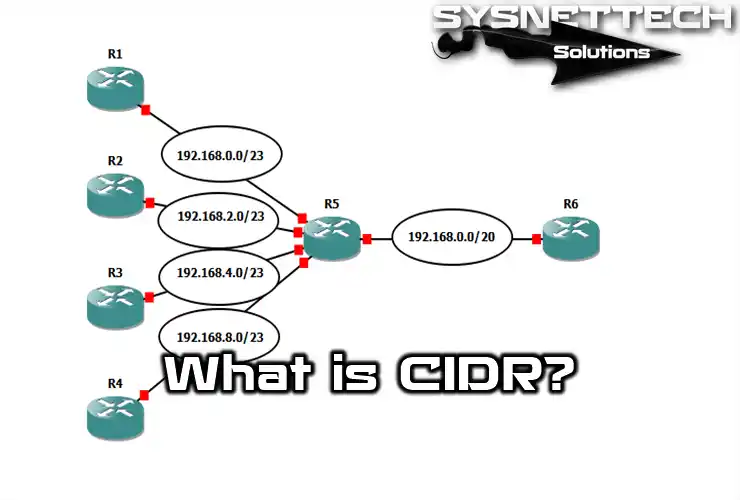
In the network topology above, R5 has four clients. Each client has a variable IP address range.
A route to R6 can summarize this address range. The route 192.168.0.0/20 includes all networks of clients A, B, C, and D.
This type of route is known as a “supernet path.” It summarizes several network addresses. The mask here is smaller than the class mask.
What Does It Do?
Creating smaller routing tables improves efficiency. Fewer entries simplify route searches.
Network administrators can use static routes to replace many dynamic routes. This change reduces the table size and makes management easier.
In many cases, one static route can represent dozens or even hundreds of routes. This approach lowers complexity significantly.
Additionally, Classless Inter-Domain Routing (CIDR) allows static paths to summarize multiple routes. This feature further minimizes the routing table size. As a result, routing decisions can be made faster.
For example, in a specific network topology, router R6 can access designated subnetworks. While this setup is functional, a static summary route would make routing more transparent and more efficient.
How Does CIDR Specifically Compare to the Classful Addressing System?
CIDR improves IP address allocation compared to the classful system. It offers flexibility by allowing variable-length subnet masking.
This optimizes the use of available address space. In the traditional classful system, network classes like A, B, and C determine the number of hosts per network.
However, CIDR allows Internet Service Providers (ISPs) to allocate addresses based on real needs.
As a result, CIDR leads to better resource management. Moreover, it creates smaller and more efficient routing tables.
These improvements enhance network performance and speed up routing decisions. In contrast, the classful system often wastes IP addresses and leads to larger table sizes.
Conclusion
In conclusion, Classless Inter-Domain Routing (CIDR) has changed IP address management. It removes the strict rules of traditional class-based assignments.
This change allows more flexible use of available address space. As a result, network performance improves.
Additionally, CIDR compresses several routes into one summary route. This action simplifies routing tables.
Consequently, it speeds up the routing process. Network administrators can make quicker decisions.
As Internet demands grow, CIDR’s role becomes even more critical. It helps maintain strong and scalable networks.
Therefore, anyone involved in network management should understand and use CIDR. This knowledge ensures optimal performance and resource use.

TolgaBagci
Hi, I'm Tolga, a computer expert with 20 years of experience. I help fix computer issues with things like hardware, systems, networks, virtualization, servers, and operating systems. Check out my website for helpful info, and feel free to ask me anything. Keep yourself in the loop about the newest technologies!